~ "By wisdom a house is built, and through understanding it is established; Through knowledge its rooms are filled with rare and beautiful treasures." ~ "Reckless words pierce like a sword, but the tongue of the wise brings healing" ~ "But the wisdom that is from above is first pure, then peaceable, gentle, and easy to be intreated, full of mercy and good fruits, without partiality, and without hypocrisy." ~ "Trust in the LORD with all your heart, and lean not on your own understanding; in all your ways acknowledge Him, and He shall direct your paths."~
Showing posts with label Peter Reinhart. Show all posts

Wednesday, January 29, 2014

New York Style Bagels... Peter Reinhart.


Chewy New York Style Bagels... Peter Reinhart. I think it's time for another bread recipe:)... haven't posted one in such a long time. While I will always be partial to my best ever bagel recipe, I have for some time wanted to make a NY-style bagel. You know, the kind that's quite chewy and dense.... and that always benefits from a good schmear of cream cheese. While my best ever bagel recipe is probably considered a West Coast type of bagel(more bread-like and light)... this version I'm posting today is more of an East Coast version(dense and chewy).

When I visited New York last year, I made it a point to stop by a popular bagel shop and try their bagels. I had looked forward to my trip,  especially looked forward to the bagels. So when I walked in the shop, I remember eyeing the basketfuls of bagels and large bins of various cream cheese schmears.... so eager was I to try a bagel! I mean New York bagels are supposed to be the best. But after tasting the bagel, I'll be honest, I was sort of  disappointed. I mean, the bagel was ok,  it just wasn't great. For some reason, I felt they almost needed that moundful of schmear they're known to top the bagels with.... to me the bagels were kind of dry and dense. Maybe that's how they're supposed to be...

This past year I decide to try my hand at making a chewy NY-style bagel....a homemade version. I figured freshly made is always best.  I've enjoyed making Peter Reinhart's bread recipes in the past, so I knew his bagel recipe would probably not disappoint. I decided to go with his less complicated method(he has a few recipes)... as it makes just 6 bakery style bagels.  I did end up making a double batch... to test the difference between the food processor method and the mixer method. Both results were similar in texture and taste.... but I prefer using the food processor, it's much quicker.

Boy, if you ever want a bagel with a chewy crust, this is it! You almost need to tug at the bagel when biting into it, it's that chewy. These bagels are meant for a cream cheese spread... less so for making sandwiches(just because of the pull and tug), though it goes extremely well with a slice of cheese and deli meat. I still love my best ever bagel recipe for making sandwiches with... especially sunny side up egg sandwiches, as it's softer and not as chewy.  But if you are looking for a small batch chewy bagel recipe, this is worth making. The bagels come out looking fantastic, with a golden blistery crust... makes you look like a professional bread baker:). Hope you enjoy...              

You will need: adapted from LA Times

Bagel Dough: makes 6 bagels, but you can easily make a second batch, as I did.

3 1/2 cups (1 pound) unbleached bread flour 
2 teaspoons table salt
3/4 teaspoon instant yeast
1 tablespoon honey(or barley malt syrup)
1 cup plus 2 tablespoons water

Water Bath:
3+ Quarts of water
1 tsp salt
1 teaspoon baking soda

Egg Wash:
1 beaten egg

Toppings:
Poppy, sesame seeds

Directions:

1. USING A FOOD PROCESSOR: In the bowl of a food processor, add the flour, 2 teaspoons salt, the yeast, honey and the water. Process for 1 minute until the ingredients form a stiff, coarse ball of dough... you may add a tiny bit of water, if needed. Let the dough rest 5 minutes. Process dough for an additional 50 seconds- 1 minute.


USING A MIXER: In a mixer bowl, add the flour, 2 teaspoons salt, the yeast, honey and the water. Knead on medium speed until the ingredients form a stiff, coarse ball of dough, about 3 minutes....you may add a tiny bit of water, if needed. Let the dough rest 5 minutes. Knead on medium speed for an additional 3 minutes...

Note: If the dough seems too soft or too tacky, sprinkle over just a bit of flour as needed. I didn't need to add any additional flour.

2. Place the dough in a lightly oiled bowl and  cover with plastic wrap. Place bowl in the refrigerator for at least 1 hour and up to several hours. I left mine for 2 hours in the fridge.

Note: The bagels must be shaped before proofing overnight.

3. Line a baking sheet with lightly greased parchment paper or a silicone baking mat.

4. Remove the dough from the refrigerator. Divide it into 6 equal pieces. 

5. Form each piece into a loose, round ball. 

With a cupped hand, roll each piece of dough on a clean, dry work surface... do not use any flour on the surface.  You can wipe the surface with a drop or two of water if the dough slides around and won't ball up... the slight amount of moisture will give you the necessary "bite" for the dough to form a ball. 

6. Roll each dough ball into a "rope" 8 to 10 inches long. From bagels.

Moisten the work surface ever so slightly if needed. Slightly taper the rope at the ends so that they are thinner than the middle. Place one end of the dough between your thumb and forefinger. Wrap the rope around your hand until the ends overlap in your palm by about 2 inches. Squeeze the overlapping ends together. Press the joined ends into the work surface and roll them back and forth a few times until sealed.

7. Remove the dough from your hand and squeeze as necessary to even out the thickness of the dough. You should have a 2 inch hole in the center. 

8. Place the bagel on parchment paper lined pan. Repeat process until all bagels are done. Placed oiled plastic wrap over bagels and place in the refrigerator overnight.


Remove the bagels from the refrigerator 90-100 minutes before you plan to bake them. 
  • Pre-heat oven to 500 degs F for 30 minutes
1. Ten or 15 minutes before baking(oven has pre-heated for at least 15 minutes), fill a large stockpot with 3 quarts of water, making sure the water is at least 4 inches deep. Cover pot with a lid, and slowly bring the water to a boil. Reduce the heat, add 1 teaspoon of salt and 1 teaspoon of baking soda. Simmer with the lid on.

Note: Test the bagels to see if they are ready for boiling by placing one in a bowl of cold water. If it sinks and doesn't float to the surface, then return it to the sheet and wait about 15 minutes and then test it again. When one bagel passes the float test, they are ready for the pot. I didn't bother with this, since I bake bagels all the time, and knew my bagels were puffed enough to float... you can tell they are lighter in the hand. But if you are new to bagels, it's best to do the float test. 

2. Gently lift each bagel and place it in the simmering water. Add 2 more bagels, or as many as will comfortably fit in the pot, but don't overcrowd. I do 3 at a time. 

3. Poach bagel for 1 minute, then flip each bagel over and poach for an extra 30 seconds. 

4. Remove each bagel using the slotted spoon, and place it on the lined baking sheet. Brush bagel with egg wash and sprinkle any toppings of choice. Repeat until all the bagels have been poached, egg washed and topped. 

5. Reduce the heat to 450 degrees FPlace the baking sheet in the oven and bake for 8 minutes. Rotate sheet and bake for an additional 8 minutes or until golden brown. 

Note: You may want to check the underside of the bagels half way through baking... if they are getting too dark, then place another sheet under the baking sheet and continue baking for the last 8 minutes. I didn't bother with this. 

6. Remove bagels from oven and transfer them to a rack. Cool for at least 30 minutes before serving. 


Friday, February 4, 2011

Peter Reinhart Pain a l'Ancienne ( Part 2)...Baguette, Rolls, Fougasse, etc.

.
.

Peter Reinhart Pain a l'Ancienne ( Part 2)...Baguette, Rolls, 'Fougasse', etc.
This particular recipe is a take on Peter Reinhart's ciabatta bread that I posted earlier. The only difference is that you will omit the oil in the ingredients and the dough doesn't actually proof for as long the next day. Other than that, the basic technique of stretching and folding the dough and the overnight refrigeration is still followed. The dough can stay refrigerated for up to 4 days... which gives you plenty of time to work with it. I find the flavor of the bread increases with time. I let my dough sit in the refrigerator for 2 days. You will need to check the ciabatta post for some of the steps in this recipe...
To be honest, I made this second batch for trial and error...to sort of "play" with the dough and create various breads. Initially, I had intended to make most of it into baguettes and with the rest, make a couple of different shapes. I just wanted to see how the dough would handle if I changed it into other types of shapes. Because I handled the dough a bit more when making the rolls, twists, and "fougasse", some of the bread holes weren't as evident in the final product. It really didn't change the taste, just was a bit less airy and the bread structure was more compact. You can see the result in the first photo of a regular baguette slice and the second photo of the twist. Less holes in the latter version. The "fougasse" was a last minute decision...even the sprinkling of the herbs was an afterthought. It turned out to be my favorite:)...
I think this dough would work really well as a pizza dough. Loved, loved the bread. I think Peter Reinhart has done a marvelous job explaining the techniques that are used to attain beautiful artisan style breads right in your own home. Hope you enjoy....

You will need: adapted from Peter Reinhart's Artisan Breads Every Day
You can also see a sample of the book with this recipe HERE

4 1/2 cups (20 oz / 567 g) unbleached bread flour( I used King Arthur)
1 3/ 4 teaspoons (0.4 oz / 11 g) table salt
1 1/4 teaspoons (0.14 oz / 4 g) instant yeast
2 cups (16 oz / 454 g) chilled water (about 55°F)

Directions:
Part 1: Day before
See instructions for this part....in PART 1 of my previous ciabatta post.
Just skip the olive oil

Part 2: Day after dough has refrigerated overnight( or up to 4 days later...I made mine on the second day)

1. Remove dough from refrigerator 1 hour before baking( by the time I got to baking everything, it was more like 1.5-2 hours for me).
2. After you remove the dough from the fridge, let dough rest at room temp for about 1 hour...
45 minutes before baking, preheat your oven to 500 deg....see preparing your oven for baking in the ciabatta post. If using a stone, place it inside the oven as well as a steam pan. Have a towel ready( to cover glass on door... so as not to crack the glass).
3. After 1 hour, line a baking sheet with parchment paper and flour it well. Set aside.
4. Flour your work surface and gently remove the dough from the bowl...(being careful not to degass the dough....you want as many bubbles in the dough as possible, which will give you those nice big bread holes).
5. Using a wet dough scraper, cut the dough in strips... and place them on the parchment paper rolling it in a bit of the flour. It is ready for baking.
~for baguettes you can leave them in strips.
~for smaller pieces, just cut the strip in half leave them as is or twist a couple together
~ for rolls, cut a small piece of dough and gently form into a ball( I just pinch the outside of the dough to a point and tuck the pinched dough inside....boy, I don't know if I explained that very well:)).
~ for "fougasse", stretch out a strip and cut a center slit and 2-3 slits on each side of the center slit..... or if you want, make it like I did, just cut a few slits in the dough:)....spray a bit of water and sprinkle a mixture of dried herbs...or leave it without the herbs.
Since I folded a few and made some into rolls, I let them proof a bit more( just because I handled them more than the plain strips/baguette). I baked the baguette and smaller strips first... while the rolls, twists and 'fougasse' I put aside to rest/ proof for half an hour( or so) while the first batch was baking. Cover the dough pieces with oiled plastic wrap(loosely) while it is resting.
6. Slide the baguettes(with parchment paper) unto the hot stone(...or simply place the whole sheet pan with the bread doughs and parchment paper).
7. Place your towel over the glass door...add 1 cup hot water to the steam pan....be VERY careful so as not to burn yourself...use oven mitts).
8. Lower oven to 475 deg...
9. Bake for 12 minutes and then turn pan over and bake for an additional 12 or so minutes ...or until rich brown all over and sounds hollow when tapped. (The baking time may vary depending how large or small your loaves are.)
10. Bake the remaining bread. Let cool before slicing.
The bread is wonderful with some smoked salmon, as a dipping bread, with ham and cheese...or whatever you like:)

Wednesday, February 2, 2011

Peter Reinhart's Pain a l' Ancienne Bread (Part 1) .... Ciabatta

.
.
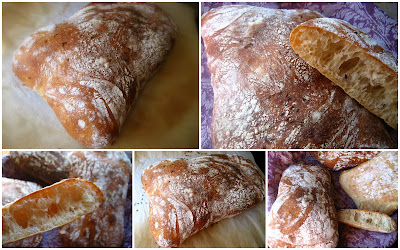
Peter Reinhart's Pain a l' Ancienne Rustic Bread (Part 1).... Ciabatta Loaves. I am a huge fan of Peter Reinhart and love his bread recipes. I have only made a few of his recipes...his 100% whole wheat bread, his pizza dough, and now his ciabatta bread. But each recipe has been a winner for me and I have learned so much from each one.
Ever since I saw the recipe on Andreea's blog(Romanian), I knew I had to make it. Her step-by-step photos were so beautiful that she inspired me to make them. I hadn't baked bread in a while, so I was quite eager to try it out.
I do have to admit that it did take me a couple of days to think about the recipe( reading it and re-reading it) before I finally started. Many times it's much easier to do something simple, something I am used to. But in order for me to learn and improve, I need to push myself....to try a recipe I may be unfamiliar with. It was good to get out of my comfort zone and make the bread.... regardless of the outcome.
So I forged ahead and decided to make 2 batches of the bread. One batch was for this ciabatta recipe while the other batch was used for making baguettes, rolls, etc.( which is Part 2...to be posted soon)....The really neat thing about making more than one batch, is that you can leave it in the fridge for up to 4 days....so you don't have to bake it all on the same day. I was quite thrilled with the final result.
I have to say, it was by far the best artisan/rustic bread I've made. The outside is nice and crisp while the inside is pleasantly soft. It's light and airy with a wonderful chew...and tastes way better than store-bought:)! For me, this was a winner of a recipe.
The process wasn't as difficult as I first thought:). The stretch and fold technique is applied to the dough... giving you a great hands-on experience. It's actually quite neat to see the different stages that's involved in bread making/baking....and then be rewarded with wonderful bread.
I think weighing the ingredients is key. Just for curiosity, I measured my flour as I usually do and noticed I would have been off by 1/4 cup-1/3 cup in comparison to weighing in grams... makes a big difference. I also like to weigh my liquids as I find it is much more accurate. Had loads of fun making the ciabatta. Will definitely be making it again....Thinking of using it as a focaccia and making the Italian Schiacciata con L'uva. If you have a free day, you might want to give this recipe a try. Start the dough the night before and finish it off the next day...or a few days later. Hope you enjoy...
NOTE: Please don't be put off by the long procedure, I have tried to make it visually helpful...it isn't really that difficult as it looks.

You will need: initially inspired by Dimineti Insorite ...and adapted from Peter Reinhart's Artisan Breads Every Day....You can also see a sample of the book with the ciabatta bread recipe HERE

4 1/2 cups (20 oz / 567 g) unbleached bread flour( I used King Arthur)
1 3/ 4 teaspoons (0.4 oz / 11 g) table salt
1 1/4 teaspoons (0.14 oz / 4 g) instant yeast
2 cups (16 oz / 454 g) chilled water (about 55°F)
1 tablespoon (0.5 oz / 14 g) olive oil

Directions:

PART 1...the night before.

1. In a mixing bowl, combine flour, yeast, salt and water. (For accuracy, I weighed my flour and water... for the rest I used my measuring teaspoons/tablespoons).
2. Using the paddle attachment, mix on low for about 1 minute.
3. Stop the mixer and let the dough rest and hydrate for 5 minutes.
4. After the dough has rested 5 minutes, add 1 TBS olive oil. Mix again( using the paddle attachment) for another 1 minute. At this point the dough is a bit smoother...but still sticky and wet.
5. Lightly oil a large bowl. Place the dough in the oiled bowl...since the dough is a bit sticky you might want to use a wet scraper or even wet hands to remove the dough.
6. Cover the bowl and let the dough rest for 10 minutes at room temp.
7. Lightly oil your work surface...you don't want to put too much oil otherwise the dough will move away from you without being able to do the stretch and fold technique, which follows.

You can see Peter Reinhart performing the stretch and fold technique in this video link:

8. Using wet or oiled hands transfer the dough unto the working surface and sort of pat it in a rough rectangle.
9. Using wet or oiled hands reach underneath the front end of the dough and stretch it out a bit before folding it on top of the dough.
10. Do the same from the back end( stretching it and folding it over).
11. Now take the left side of the dough( from underneath) and fold over...do the same with the right side.
12. Flip the dough over and tuck the dough in to form a ball. Place the dough ball back in the oiled bowl.
13. Let the dough rest for 10 minutes and repeat process 2 more times for a total of 3 times...all stretching and folding should be done within 40 minutes.

14. Place the dough in the bowl, cover tightly, and refrigerate.

PART 2/ Next day( or up to 4 days later)

1. Remove dough from refrigerator 3 hours before baking.
2. After you remove the dough from the fridge, let dough rest at room temp for about 1 hour.
3. After 1 hour, line a baking sheet with parchment paper and flour it well. Set aside.
4. Flour your work surface and gently remove the dough from the bowl...(being careful not to degass the dough....you want as many bubbles in the dough as possible, which will give you those nice big bread holes).
5. Using a wet dough scraper, cut the dough in 3 strips...(or as many ciabattas as you plan on making).
6. Fold each strip like a letter... left side over and then right side over left.
7. Turn the folded dough over(seam side down) and place on floured parchment....rolling it a bit(gently) in the flour so that it won't stick. Do the same with the other strips.
8. Cover with oiled plastic wrap and let rise for about 1 hour.
9. After 1 hour, gently turn the dough over so that the seam is up. Gently place your hands underneath the folded dough and stretch it to about 7 inches if doing larger ciabattas(less if doing smaller ciabattas). Place the stretched dough(seam side up) back unto the floured parchment. Repeat the process with the remaining pieces.
10. Cover the stretched dough pieces with oiled plastic wrap(loosely) and let proof for another 1 hour....you should see large bubbles on the surface of the stretched out dough.
It is at this time you may want to do a little bit of cleaning:) and then get the oven ready for pre-heating.
11. Close to 45 minutes before baking, get your oven ready by preheating it to 550... or as high as your oven heats...mine goes to 500 deg. If using a stone, place it inside as well. I also place a steam pan( broiler pan that came with the oven...don't use glass) as well.
Have a towel ready( to cover glass on door... so as not to crack the glass).

You can see Peter Reinhart explaining how to get your oven ready for baking in this video link:

12. After the 45 minute rise, slide the ciabatta bread doughs(with parchment paper) unto the hot stone(...or simply place the whole sheet pan with the bread doughs and parchment paper).
13. Place your towel over the glass door...add 1 cup hot water to the steam pan....be VERY careful so as not to burn yourself...use oven mitts). Take towel off and....
14. Lower oven to 450 deg...
15. Bake for 12 minutes and then turn pan over and bake for an additional 12 or so minutes ...or until rich brown all over and sounds hollow when tapped. (The baking time may vary depending how large or small your ciabatta loaves are.)
16. Let cool on wire rack for an hour or so before slicing.

You can freeze the bread and re-heat in oven to crisp up again.

Monday, September 20, 2010

Peter Reinhart's (Napoletana) Pizza Dough....Grilled and Baked

Baked pizza...
Grilled pizza...

Peter Reinhart's Napoletana Pizza Dough....Grilled/Baked. For some time now, I have been experimenting with pizza doughs....grilled and baked pizzas. I love working with any type of bread dough, so experimenting with pizza doughs was actually quite fun for me...
Ever since my husband had his first taste of grilled pizza, he's been requesting it quite often. He loves the smoky, "wood-fired" flavor of the grilled pizza. I knew he wouldn't mind having pizza more than once a week...while I was experimenting:).
I decided to try some other pizza dough recipes... just to see if I could come up with another "favorite" pizza dough(besides the usual recipe I use). In the process, I came across Peter Reinhart's Napoletana Pizza. It seemed that everyone was raving about it. I was willing to give it a try, especially since I absolutely love his 100% whole wheat bread recipe. I knew the pizza dough would probably not disappoint. He does have a variation to this pizza dough recipe, found in his cookbook~ Bread Baker's Apprentice. The recipe that I used, via The Fresh Loaf, can be found in his American Pie cookbook. Both recipes are similar...except one uses bread flour, more oil, and icy cold water( instead of the room temp). However, they both require you to refrigerate the dough overnight... giving you better flavor and texture.
In any case, I ended up doing a pizza on the grill (my adaptation) and another in the oven (original version). I really liked them both. The neat thing about it is that you can make the dough in advance and even freeze it for later use.....you just need to thaw it in the fridge the night before you want to bake it and allow ample time for it to get to room temp before using it. I loved the taste and the slight chew the dough had...it was a light( airy) sort of dough and not dense at all. I have posted the grilled version, as well as the baked. Feel free to do whatever version you prefer. Hopefully, it is not confusing:)... You know, I really liked it and will be making it again.
BTW, the toppings I used were not authentic Napoletana... typical tomatoes, and mozzarella cheese. I chose to add a few more toppings( just because I had some other veggies that needed to be used up) and therefore the pizza isn't a true Napoletana pizza. So I put the Napoletana in parentheses. Do feel free to make the original Napoletana version. Hope you enjoy....

The Dough: From: Peter Reinhart's cookbook American Pie via: The Fresh Loaf
~Makes 4(10-inch) pizzas~
5 cups all purpose flour
1 Tablespoon sugar or honey
2 teaspoons salt (or 3 1/2 teaspoons kosher salt)
1 teaspoon instant yeast
2 Tablespoons olive oil
1 3/4 - 2 cups room temp. water

Directions:

Day 1:
Combine all of the ingredients in a large mixing bowl and mix/knead for 2 minutes. Let rest for 5 minutes. Knead again for 3 to 5 minutes, adding more water or flour if necessary. You want the dough to be wetter and stickier than your typical bread dough but it should still be dry enough that it pulls away from the side of the bowl when you mix it. The dough should only stick to the bottom of the mixer bowl.
Divide the dough into 4 pieces. Place each one into an oiled freezer bag or you can brush the outside of the dough with olive oil and then place it into the bag. Leave in the fridge overnight.
Day 2:
~If you aren't going to bake them the following day, you can place the bags in the freezer. The evening before you intend to bake them, remove the frozen dough balls to the refrigerator to thaw.~
Remove the dough from the fridge( stretch it out a bit) and let it warm to room temperature for 2+ hours( mine took well over 2 hours, more like 3 hrs.) before you intend to bake it. The dough should have a room temp feel and not be cold. You should see small bubbles in the dough ... especially when you lift the edge of the dough...you basically want to see that the yeast is activated.(see photo). So, depending on the temp in the house the time can vary. I like to place my dough where the sun beats on it and warms it(just make sure you cover it with a plastic wrap so that the dough doesn't form a skin).
Grilling the pizza:
Take the dough place it on a piece of wax/parchment paper and squirt some oil on it. Begin to stretch the dough with your hands into a circle( or whatever shape you like). I like to stretch my dough rather than roll it. You get more bubbles(air pockets) in the dough that way. Preheat your grill to med/high . Place the dough on the grill and peel the wax paper....the wax paper helps you keep the shape of the dough as you transfer it onto the grill...you can skip the wax paper if you like. Cook the pizza dough until the top becomes dry and the bottom has a nice crust.
Turn over and lower the heat a bit. Immediately add the sauce and toppings. You can also remove the pizza from the grill while adding the toppings and then place it back on the grill . (It is probably easier to do it this way, especially if you are doing it for the first time).
Grill until cheese is melted....lifting and checking the bottom of the dough so as not to burn. Drizzle a bit of olive oil and sprinkle with crushed red pepper.
A really good "secret" is to brush the grilled pizza dough with a mixture of crushed garlic and olive oil... before adding any other toppings. You can also use marinara sauce....even some bbq sauce with grilled chicken.....

Baking the pizza: Preheat your oven and pizza stone at 450-475 deg for about 30-40 minutes or so. I like to place my pizza stone on the lower third rack of the oven. This way, I get a nice bottom crust and the cheese doesn't burn.
Place some oil on a piece of parchment paper and begin to stretch out the dough in a circle. I like to stretch my dough thin in the center and leave a thicker crust on the outside. Spread your favorite sauce and toppings. Using a pizza peel or the back of a cookie sheet, place the pizza along with the parchment paper onto the preheated stone and bake for about 8 minutes(+/-, depending on thickness and oven temp.).
The cheese should be bubbling and the bottom of the crust golden and crispy.

Friday, January 22, 2010

Peter Reinhart’s 100 % Whole Wheat Sandwich Bread


Peter Reinhart’s 100 % Whole Wheat Sandwich Bread Ok, so I am in a bread baking mood as of late. I really have come to LOVE bread baking...and the more I bake, the better I get at it. Of course, I am still learning... I can still remember how scared I was of making bread. Actually, I avoided any recipe that listed yeast as an ingredient. I just didn't want to mess around with it....didn't want to be disappointed. So for the longest time, I stayed away from those little packets of yeast. I always figured it was meant for those who were professionals.... or like my mom, who always used yeast as if it was no big deal. My mom made wonderful pizza dough, cozonac, gogosi (Romanian version of doughnuts) and various other doughs. I would see her making the dough, adjusting amounts as she went along. She would add more flour if she felt the dough needed it, or maybe adjust the amount of liquid, and so on. So, when I first started using yeast, I wanted spectacular results...sort of like my mom's:). I mean, I wanted the final product to be perfect! Oh, believe me, it wasn't perfect by any means...but I slowly learned how the dough should feel. I also found out that certain factors can affect the final result ...such as the humidity on that particular day, the right temp. of the liquid(not too hot, not too cold) and the need for the dough to rise in a WARM environment. I also learned that properly mixing the dough was just as important. I started out kneading the dough by hand. That was fun ...for a while. But then my hand would get too tired ...and that wasn't fun. Even though I gained valuable experience kneading the dough by hand, I didn't want it to become a chore, or even worse, disliking it. I wanted to enjoy it. I was thrilled when my husband eventually bought me a Kitchen-Aid mixer. From then on, it was a piece of cake:)!! Well, almost...at least the kneading part was. I am still learning about bread baking to this day. I really like to try a different bread recipe every so often....it just helps me practice my bread making skills.
This post was inspired by Peter Reinhart, a genius at bread baking. Well, I consider him a genius because he came up with a 100% WHOLE WHEAT bread that's TASTY, FLUFFY and TENDER! It slices beautifully. 100% whole wheat?...yes! Trust me, this bread is really good....DELICIOUS! We love it, and the recipe is definitely a keeper. I originally saw this recipe HERE and took the challenge to make it myself. Ok, so the recipe may look long and tedious. It really does involve two days!...yes, two days. But, you really don't have to do too much. The dough just needs to rest and get hydrated. This in fact is what makes the bread so soft and tender vs. other 100% whole wheat breads. It also gets better flavor as it rests... and since I like to bring in whole grains into our diet, I was up for the challenge. The bread was fantastic. Worth the time. Of course, since I was going through all that trouble, I decided to make 2 loaves. Glad I did. Hope you enjoy...

YOU WILL NEED: Just a note, I did measure my ingredients using the scale this time around. I didn't need to adjust anything... Oh yes, I finally got a kitchen scale!:)

~~~~~~~~~~~STEP 1~~~~~~~~~~~~~

For the Biga (Pre-fermented Dough):
1 3/4 cups (227 grams)whole wheat flour
1/4 tsp instant yeast
3/4 cup (170 grams)water, at room temperature

Biga (Pre-fermented Dough) Directions:
1. Mix the biga ingredients until a shaggy ball of dough is formed. Knead the biga for about 2 minutes or until the ingredients are evenly distributed.
2. Place the biga in a bowl and cover.

3. Refrigerate for at least 8 hours and up to 3 days. Let the biga sit at room temperature for about 2 hours before using in the final dough.

~~~~~~~~~~~~STEP 2~~~~~~~~~~~~~~~

For the Soaker:
1 3/4 cups( 227 grams) whole wheat flour
1 tsp (4 grams) kosher salt
3/4 cup + 2 TBS (198 grams) whole milk

Soaker Directions:

1. Mix the soaker ingredients until evenly hydrated. Cover and leave at room temperature for 12 to 24 hours.


~~~~~~~~~~~~~STEP3~~~~~~~~~~~~~

Final Dough Formula:
all of the biga (Step 1), cut into small pieces
all of the soaker (Step 2), cut into small pieces
7 TBS (57 grams) whole wheat flour
1/2 TBS (5 grams) kosher salt
2 1/4 tsp (7 grams) instant yeast
2 1/4 TBS (43 grams) honey
1 TBS (14 grams) unsalted butter, melted

Final Dough Instructions:

1.Mix all of the ingredients until evenly incorporated.

2. Knead 8 to 10 minutes I kneaded mine for 8 using my Kitchen-Aid mixer

3. Rest 5 minutes.

4. Knead 1 minute to further strengthen the gluten.

5. Let rise for 45 to 60 minutes at room temperature, in a lightly oiled bowl, or until 1 1/2 times its size.


6. Shape loaf and place in a greased 8 1/2 x 4 1/2 loaf pan ( I like to use parchment paper on the bottom.).... you can also use a 9x5 loaf pan, though it probably won't get such a high rise. The smaller pan works a bit better.

7. Roll bread dough similarly to a jelly roll style.

8. Pinch the seam so that the dough won't unravel and place seam side down in a parchment lined(or greased) loaf pan/s.

9. Preheat Oven 425ºF/218ºC...you will only need to pre-heat the oven at 425 deg F.... you will bake the bread at 350 deg. F.

10. Final Proof: Let dough rise for 45 to 60 minutes, at room temperature, or until 1 1/2 times its size.

Before baking: Lower the oven temp immediately to 350 deg.
11. Place the loaf on the middle rack and bake for 20 minutes. Rotate pans and bake for another 20 minutes ( I like to loosely cover my loaves with aluminum foil to prevent overbrowning in the last 10 minutes or so). OR until the loaf is a rich brown on all sides and registers at least 195 deg.F in the center. I like to brush my bread with a bit with melted butter...that's why the loaf is so shiny. It won't stay shiny...just softens the crust a bit.


12. Transfer the bread to a cooling rack and allow it to cool for at least 1 hour before serving.
You can definitely freeze the bread....actually, I recommend it. Just wrap it well.